
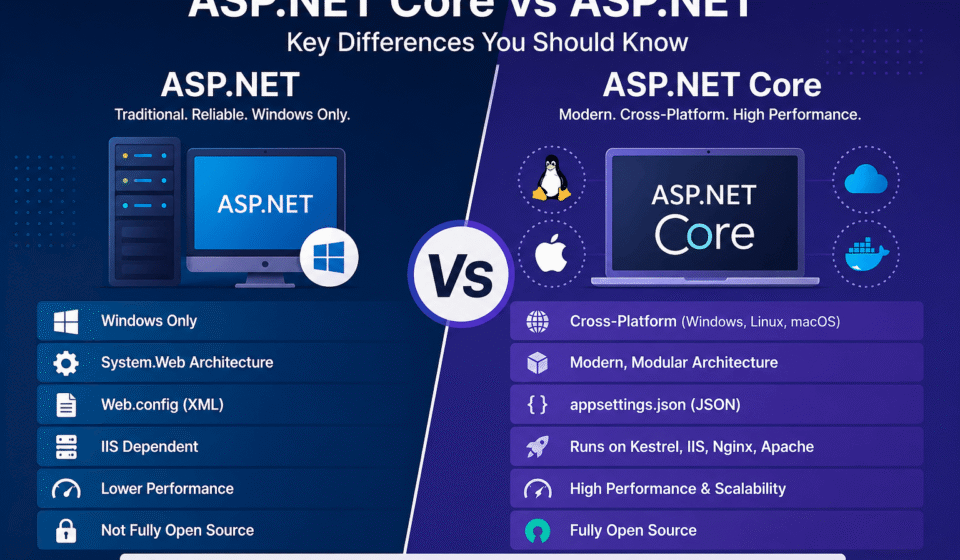
ASP.NET Core vs ASP.NET Difference: Complete Comparison, Performance Insights, and Future Scope

Understanding the ASP.NET Core vs ASP.NET difference is crucial for developers aiming to build scalable, high-performance web applications. Microsoft has significantly evolved its web frameworks to meet modern development needs, transitioning from traditional ASP.NET to the more advanced ASP.NET Core.
While both frameworks serve the purpose of web development, they differ in architecture, performance, deployment, and flexibility. In this article, we will explore a detailed comparison to help you choose the right framework.
What is ASP.NET?
ASP.NET is a mature web development framework built on the .NET Framework and primarily designed for Windows environments. It has been widely used for enterprise applications over the years.
- Runs only on Windows
- Uses System.Web architecture
- Supports Web Forms, MVC, and Web API
- Dependent on IIS (Internet Information Services)
- Uses web.config (XML-based configuration)
What is ASP.NET Core?
ASP.NET Core is a modern, open-source, cross-platform framework designed to build cloud-based applications, APIs, and microservices with high performance.
- Cross-platform (Windows, Linux, macOS)
- Lightweight and modular architecture
- Built-in Dependency Injection
- Supports cloud and microservices
- Uses appsettings.json for configuration
ASP.NET Core vs ASP.NET Difference (Detailed Comparison)
1. Platform Support
ASP.NET runs only on Windows, whereas ASP.NET Core supports Windows, Linux, and macOS. This makes ASP.NET Core ideal for modern cloud-based deployments.
2. Performance
ASP.NET Core offers significantly better performance due to its lightweight design and optimized request pipeline. It handles high traffic more efficiently than ASP.NET.
3. Architecture
ASP.NET follows a monolithic architecture using System.Web, while ASP.NET Core uses a modular architecture, allowing developers to include only necessary components.
4. Dependency Injection
ASP.NET Core has built-in Dependency Injection support, making applications more maintainable and testable compared to ASP.NET.
5. Hosting Flexibility
ASP.NET requires IIS, whereas ASP.NET Core can run on multiple servers like Kestrel, IIS, Nginx, and Apache.
6. Configuration System
ASP.NET uses web.config (XML), while ASP.NET Core uses appsettings.json, environment variables, and command-line configuration.
7. Open Source
ASP.NET Core is fully open-source and maintained on GitHub, allowing community contributions and faster updates.
8. Cloud & Microservices Support
ASP.NET Core is built for cloud-native applications and supports Docker and Kubernetes, making it ideal for microservices architecture.
Performance Comparison
In terms of speed, scalability, and resource utilization, ASP.NET Core outperforms ASP.NET. Its optimized middleware pipeline and asynchronous programming model contribute to faster response times.
When to Use ASP.NET?
- Maintaining legacy applications
- Applications dependent on Windows-only features
- Existing enterprise systems with heavy investments
When to Use ASP.NET Core?
- Building new web applications
- Creating REST APIs
- Developing microservices
- Cloud-based deployments
- Cross-platform applications
Migration from ASP.NET to ASP.NET Core
Migrating to ASP.NET Core can improve performance and scalability, but it requires proper planning.
- Analyze the existing application
- Identify dependencies
- Rewrite incompatible modules
- Test thoroughly before deployment
Internal & Outbound Resources
Read more about ASP.NET Core API Integration for deeper understanding.
Visit the official Microsoft documentation here:
ASP.NET Core Documentation
Conclusion
The ASP.NET Core vs ASP.NET difference clearly shows that ASP.NET Core is the future of web development. It is faster, more flexible, and designed for modern cloud-based environments. While ASP.NET is still relevant for legacy systems, developers should prefer ASP.NET Core for new projects.