
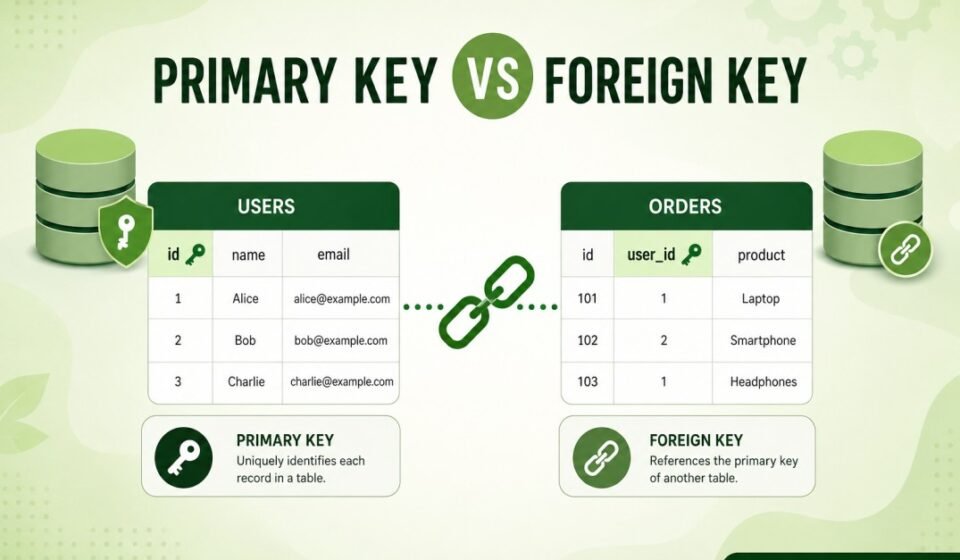

Primary Key vs Foreign Key: Complete Guide for Developers
Databases are the backbone of modern applications. Whether you are building a small CRUD application, a large enterprise system, or a cloud-based SaaS platform, understanding database relationships is essential. One of the most important concepts in relational database design is understanding the difference between primary key vs foreign key.
Developers working with MySQL, PostgreSQL, SQL Server, Oracle, or SQLite regularly use these keys to maintain data consistency, improve query performance, and build reliable relationships between tables.
In this guide, you will learn what primary keys and foreign keys are, how they work together, real-world examples, SQL syntax, and best practices every software developer should know.
What is a Primary Key?
A primary key is a column or combination of columns that uniquely identifies each row in a database table. Every table should ideally have a primary key because it ensures that no duplicate rows exist.
Main Characteristics of a Primary Key
- Each value must be unique
- NULL values are not allowed
- Only one primary key can exist per table
- Improves indexing and query performance
Example of Primary Key
Consider a simple Users table:
Users Table
--------------------------------
UserID | Name     | Email
--------------------------------
1      | John     | john@email.com
2      | Sarah    | sarah@email.com
3      | Alex     | alex@email.com
Here, UserID acts as the primary key because every user has a unique identifier.
SQL Example
CREATE TABLE Users (
    UserID INT PRIMARY KEY,
    Name VARCHAR(100),
    Email VARCHAR(100)
);
What is a Foreign Key?
A foreign key is a column in one table that references the primary key in another table. It creates a relationship between two tables and helps maintain referential integrity.
In simple terms, a foreign key connects related data across tables.
Main Characteristics of a Foreign Key
- Creates relationships between tables
- Can contain duplicate values
- Can allow NULL values depending on design
- Ensures data consistency
Example of Foreign Key
Suppose you have an Orders table.
Orders Table
--------------------------------
OrderID | UserID | Product
--------------------------------
101     | 1      | Laptop
102     | 2      | Mouse
103     | 1      | Keyboard
Here, UserID in the Orders table is a foreign key because it references the UserID primary key in the Users table.
SQL Example
CREATE TABLE Orders (
    OrderID INT PRIMARY KEY,
    UserID INT,
    Product VARCHAR(100),
    FOREIGN KEY (UserID) REFERENCES Users(UserID)
);
Primary Key vs Foreign Key: Core Difference
| Feature | Primary Key | Foreign Key |
|---|---|---|
| Purpose | Uniquely identifies records | Creates relationships between tables |
| Duplicate Values | Not allowed | Allowed |
| NULL Values | Not allowed | Can be allowed |
| Number Per Table | Only one | Multiple allowed |
| Main Use | Uniqueness | Relationship mapping |
Why Primary Keys Are Important
Primary keys are essential because they ensure every row is uniquely identifiable. Without a primary key, duplicate data can easily enter the system.
Imagine an eCommerce platform with thousands of customers. If two customers accidentally share the same identifier, order management, authentication, and payment systems could fail.
Primary keys also improve indexing. Most database engines automatically create indexes for primary keys, making searches and joins significantly faster.
Why Foreign Keys Matter
Foreign keys help maintain data integrity across tables. They prevent invalid references and ensure relationships remain consistent.
For example, if an order references a UserID that does not exist in the Users table, the database can reject the insert operation.
This reduces orphaned records and keeps your application data reliable.
Real-World Example
Consider a blogging platform.
Authors Table
AuthorID | Name
------------------------
1        | David
2        | Emma
Posts Table
PostID | AuthorID | Title
------------------------------------
10     | 1        | SQL Basics
11     | 2        | REST API Guide
12     | 1        | Database Indexing
Here:
- AuthorID in Authors table is the primary key
- AuthorID in Posts table is the foreign key
This relationship allows developers to retrieve all posts written by a specific author using SQL joins.
SQL Join Example
SELECT Authors.Name, Posts.Title
FROM Authors
INNER JOIN Posts
ON Authors.AuthorID = Posts.AuthorID;
Referential Integrity Explained
Referential integrity ensures relationships between tables remain accurate.
If a foreign key references a primary key, the database engine checks whether the referenced value exists.
For example:
INSERT INTO Orders (OrderID, UserID, Product)
VALUES (104, 50, 'Monitor');
If UserID 50 does not exist in the Users table, the database may reject the operation.
This feature protects applications from inconsistent data.
Types of Relationships in Databases
One-to-One Relationship
One record in Table A relates to one record in Table B.
Example: Users and UserProfiles.
One-to-Many Relationship
One record in Table A relates to multiple records in Table B.
Example: One customer can place many orders.
Many-to-Many Relationship
Multiple records in one table relate to multiple records in another.
Example: Students and Courses.
A junction table is commonly used to handle many-to-many relationships.
Best Practices for Primary Keys
- Use integer-based IDs whenever possible
- Keep primary keys short and efficient
- Avoid changing primary key values
- Use auto-increment fields for scalability
- Always index important keys
Best Practices for Foreign Keys
- Always define relationships clearly
- Use cascading rules carefully
- Index foreign keys for better performance
- Prevent unnecessary NULL values
- Maintain naming consistency across tables
Common Mistakes Developers Make
Ignoring Foreign Key Constraints
Some developers skip foreign keys for faster development. This often creates inconsistent and unreliable data.
Using Large String-Based Keys
Large text-based primary keys can slow down indexing and joins.
Not Indexing Foreign Keys
Without indexing, complex joins become slow in production databases.
Using Business Logic as Primary Keys
Avoid using email addresses or usernames as primary keys because these values can change.
Primary Key vs Foreign Key in SQL Server and MySQL
The concept of primary and foreign keys remains similar across most relational database systems.
Whether you use MySQL, PostgreSQL, SQL Server, or Oracle Database, the syntax and functionality are largely consistent.
You can learn more from the official MySQL documentation:
Conclusion and Next step
Understanding primary key vs foreign key is fundamental for every software developer working with relational databases.
Primary keys uniquely identify records, while foreign keys connect related tables and maintain data integrity. Together, they form the foundation of relational database design.
Whether you are building APIs, enterprise software, CMS platforms, or eCommerce applications, using proper database relationships improves scalability, reliability, and performance.
Mastering these concepts will help you design cleaner schemas, write efficient SQL queries, and build production-ready applications.
Entity relationships rely on key definitions to maintain referential integrity across tables. To master relational schema design, read our comprehensive SQL Server Tutorial: Complete Guide for Beginners to Advanced. See how constraints protect data in Understanding SQL Constraints, combine primary-foreign tables using SQL JOIN Explained, and organize relational structures using SQL Normalization Explained.