
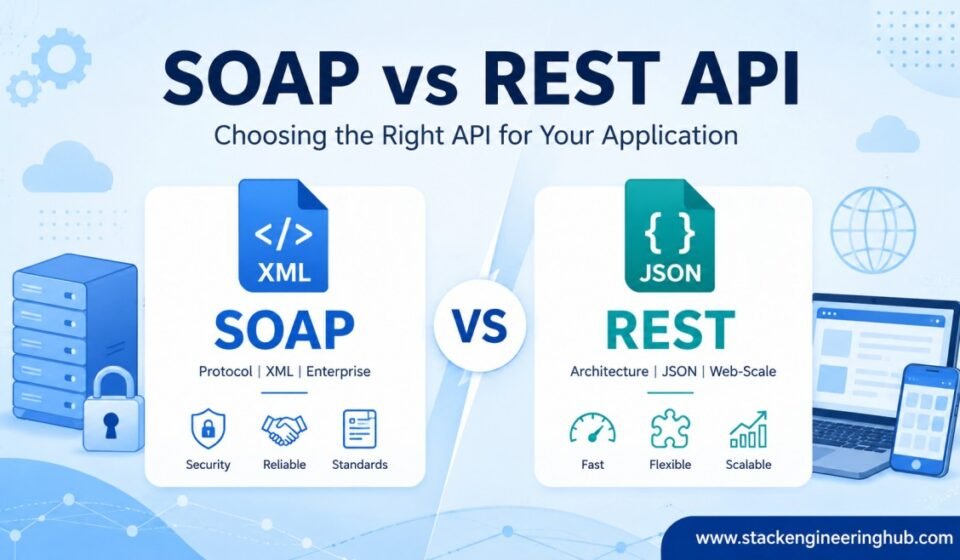

SOAP vs REST API: Key Differences, Pros, Cons and Use Cases
SOAP vs REST API is one of the most common comparisons developers encounter when designing modern applications. Whether you are building web applications, mobile apps, cloud platforms, enterprise systems, or microservices, understanding the differences between SOAP vs REST API architectures can significantly impact performance, scalability, security, and maintainability.
In this comprehensive guide, we will compare SOAP and REST APIs in detail, explain their architecture, advantages, disadvantages, security features, and real-world use cases. By the end of this article, you will have a clear understanding of when to choose SOAP and when REST is the better option.
What Is a SOAP API?
SOAP stands for Simple Object Access Protocol. It is a protocol designed for exchanging structured information between applications over a network. SOAP was developed by Microsoft and later became a W3C standard. Unlike REST, SOAP follows strict standards and specifications for message formatting, communication, security, and error handling.
SOAP messages are always written in XML format. Every request and response follows a predefined XML structure known as an envelope. This standardized approach ensures consistency across systems, making SOAP a preferred choice for enterprise-level applications that require reliability and strict compliance.
Key Characteristics of SOAP
- Protocol-based architecture
- Uses XML exclusively for message exchange
- Supports ACID-compliant transactions
- Built-in error handling standards
- Supports WS-Security for advanced security requirements
- Works over HTTP, HTTPS, SMTP, TCP, and other protocols
- Strong contract definition through WSDL
SOAP services typically expose their functionality using WSDL (Web Services Description Language). WSDL acts as a contract between the service provider and the client, describing available operations, request formats, response structures, and communication endpoints.
Example SOAP Request
POST /UserService HTTP/1.1
Host: api.example.com
Content-Type: text/xml

<soap:Envelope xmlns:soap="http://schemas.xmlsoap.org/soap/envelope/">
   <soap:Body>
      <GetUserRequest>
         <UserId>101</UserId>
      </GetUserRequest>
   </soap:Body>
</soap:Envelope>
The XML structure makes SOAP messages highly structured and reliable, but it also increases payload size compared to modern alternatives.
What Is a REST API?
REST stands for Representational State Transfer. Unlike SOAP, REST is not a protocol. It is an architectural style introduced by Roy Fielding in his doctoral dissertation. REST defines a set of constraints that developers can follow when designing web services.
REST APIs are designed around resources. Each resource is identified through a unique URL and can be manipulated using standard HTTP methods such as GET, POST, PUT, PATCH, and DELETE. REST commonly uses JSON for data exchange, although XML, HTML, and plain text can also be supported.
Key Characteristics of REST
- Architectural style rather than a protocol
- Lightweight communication model
- Supports multiple data formats
- Uses standard HTTP methods
- Stateless communication
- Easy integration with web and mobile applications
- Highly scalable and flexible
The simplicity of REST makes it extremely popular for modern cloud-native applications, SaaS platforms, mobile applications, and microservices architectures.
Example REST Request
GET /api/users/101 HTTP/1.1
Host: api.example.com
Accept: application/json
Example Response:
{
  "id": 101,
  "name": "John Doe",
  "email": "john@example.com"
}
Compared to SOAP XML messages, REST responses using JSON are significantly smaller and easier for developers to read and process.
SOAP vs REST API: Core Architectural Differences
The most important distinction between SOAP and REST is that SOAP is a protocol while REST is an architectural style. This difference impacts how services are designed, implemented, and maintained.
| Feature | SOAP | REST |
|---|---|---|
| Type | Protocol | Architectural Style |
| Data Format | XML Only | JSON, XML, HTML, Text |
| Performance | Slower | Faster |
| Scalability | Limited | Highly Scalable |
| Security | WS-Security | HTTPS, OAuth, JWT |
| State Management | Can Be Stateful | Stateless |
| Learning Curve | Complex | Easy |
SOAP vs REST API: Performance Comparison
Performance is one of the primary reasons why many modern applications prefer REST over SOAP. Since SOAP messages are XML-based and contain extensive metadata, the size of each request and response is generally larger. Parsing XML also requires additional processing power.
REST APIs frequently use JSON, which is lightweight and easier to parse. Smaller payload sizes result in faster communication between clients and servers. This performance advantage becomes even more significant in mobile applications and microservices environments where network efficiency is critical.
For example, a mobile application fetching user profile data can receive a compact JSON response from a REST API in a fraction of the bandwidth required for an equivalent SOAP XML response.
SOAP vs REST API: Security Comparison
Security is one area where SOAP has traditionally excelled. SOAP includes built-in security standards known as WS-Security. These standards provide message encryption, digital signatures, authentication, and integrity verification at the protocol level.
Because of these capabilities, SOAP remains popular in industries such as banking, healthcare, insurance, and government systems where regulatory compliance and secure transactions are mandatory.
REST does not provide built-in security standards. Instead, REST APIs typically rely on HTTPS for encrypted communication and use authentication mechanisms such as OAuth 2.0, JWT tokens, API keys, and OpenID Connect.
Modern REST security approaches are highly effective and sufficient for most business applications. However, SOAP still offers advantages in environments requiring advanced message-level security.
SOAP Security Features
- WS-Security
- XML Encryption
- XML Signature
- SAML Authentication
- Message Integrity Validation
REST Security Features
- HTTPS/TLS Encryption
- OAuth 2.0
- JWT Authentication
- API Keys
- OpenID Connect
Scalability and Flexibility
Modern distributed systems require APIs that can scale efficiently as traffic grows. REST was designed with stateless communication principles. Every request contains all information required for processing, allowing servers to handle requests independently.
This stateless nature makes REST APIs highly scalable because load balancers can distribute requests across multiple servers without worrying about session state. Cloud-native applications and microservices architectures benefit significantly from this design.
SOAP services can support stateful operations, which may be necessary for certain enterprise workflows. However, maintaining state increases complexity and can reduce scalability in high-traffic environments.
Ease of Development and Maintenance
Developer productivity is another major factor when choosing between SOAP and REST. REST APIs are generally easier to design, test, document, and consume. Most modern programming languages, frameworks, and cloud platforms provide built-in support for REST development.
Tools such as Postman, Swagger, and OpenAPI have simplified REST API development and documentation. Developers can quickly create endpoints, test requests, and generate client SDKs.
SOAP development often involves WSDL contracts, XML schemas, and specialized libraries. While these standards improve reliability, they also increase development complexity and maintenance effort.
For modern web applications, startups, SaaS products, and mobile platforms, REST typically offers a faster development experience.
SOAP vs REST API Use Cases: When SOAP Is the Better Choice
Despite the growing popularity of REST, SOAP continues to play an important role in enterprise environments where reliability and security are critical.
- Banking systems
- Payment gateways
- Healthcare applications
- Government platforms
- Enterprise resource planning systems
- Telecommunications infrastructure
“`html
SOAP vs REST API Use Cases: When REST Is the Better Choice
REST APIs have become the standard choice for modern application development because of their simplicity, flexibility, and scalability. Most public APIs available today follow REST principles and use JSON as the primary data format.
- Mobile applications
- Single-page web applications
- Microservices architectures
- Cloud-native applications
- SaaS platforms
- Social media APIs
- E-commerce platforms
- IoT applications
Major technology companies such as Google, Amazon, Microsoft, Stripe, and GitHub provide REST-based APIs for developers. These APIs are designed to be easy to integrate, lightweight, and suitable for high-volume traffic environments.
SOAP vs REST API: Advantages of SOAP
SOAP offers several benefits that make it valuable for enterprise-grade applications and mission-critical systems.
- Strong security through WS-Security standards
- Built-in error handling mechanisms
- Formal contract definitions using WSDL
- Reliable messaging support
- Transaction compliance with ACID principles
- Protocol independence beyond HTTP
- Standardized enterprise integration capabilities
Organizations operating in highly regulated industries often prefer SOAP because its standards-based architecture provides predictable behavior and advanced security features.
Disadvantages of SOAP
Although SOAP provides strong enterprise capabilities, it also introduces several challenges for developers and organizations.
- Larger XML payload sizes
- Higher bandwidth consumption
- More complex implementation
- Slower performance compared to REST
- Steeper learning curve
- Less suitable for mobile applications
- Increased maintenance overhead
For many modern applications, these disadvantages outweigh SOAP’s benefits, especially when rapid development and scalability are priorities.
Advantages of REST
REST has gained widespread adoption because it aligns well with the needs of modern software development. Its lightweight architecture and flexibility make it suitable for a wide variety of applications.
- Simple and easy to understand
- Lightweight data exchange using JSON
- Excellent performance
- Highly scalable architecture
- Wide framework and tooling support
- Ideal for web and mobile applications
- Easy integration with cloud services
- Lower development costs
Development teams can build, test, and deploy REST APIs faster than SOAP services in most scenarios. This speed contributes to shorter release cycles and improved productivity.
Disadvantages of REST
Despite its popularity, REST is not perfect. Developers should understand its limitations before choosing it for enterprise projects.
- No built-in security standard equivalent to WS-Security
- Lack of strict contract enforcement by default
- Can lead to inconsistent API designs if standards are not followed
- Limited support for advanced transactional requirements
- Versioning strategies require careful planning
Most of these limitations can be addressed using modern API management practices, documentation standards, and authentication frameworks.
SOAP vs REST: Which One Should You Choose?
The decision between SOAP and REST should be based on business requirements, security needs, performance expectations, and system architecture goals.
Choose SOAP When
- Your application requires advanced security standards.
- You need reliable messaging and guaranteed delivery.
- Regulatory compliance is mandatory.
- Complex business transactions must be supported.
- You are integrating with legacy enterprise systems.
- Formal contracts and strict schemas are required.
Choose REST When
- You are building modern web applications.
- You need high performance and scalability.
- Your application serves mobile devices.
- You are implementing microservices.
- You want faster development cycles.
- You need lightweight communication between services.
For most new software projects today, REST is generally the preferred choice because of its flexibility, simplicity, and compatibility with cloud-native architectures. However, SOAP remains highly relevant in enterprise environments where security, compliance, and transactional reliability are top priorities.
SOAP vs REST in ASP.NET Core
ASP.NET Core primarily focuses on REST API development. The framework includes built-in support for routing, JSON serialization, authentication, authorization, OpenAPI documentation, and dependency injection, making REST API development efficient and developer-friendly.
Creating a REST API in ASP.NET Core is straightforward. Developers can define controllers, endpoints, and HTTP methods while leveraging built-in middleware for security and performance optimization.
SOAP services can also be implemented in .NET environments using libraries such as CoreWCF, which is the community-driven successor to Windows Communication Foundation (WCF). This enables organizations to maintain compatibility with existing SOAP-based systems while adopting modern .NET technologies.
Best Practices for API Design
Regardless of whether you choose SOAP or REST, following API design best practices improves maintainability, performance, and developer experience.
- Use consistent naming conventions.
- Implement proper authentication and authorization.
- Document APIs thoroughly.
- Apply versioning strategies.
- Validate all incoming requests.
- Handle errors consistently.
- Monitor API performance and usage.
- Use HTTPS for all communications.
For official guidance on REST architecture, refer to the trusted resource provided by the Mozilla Developer Network.
REST API Documentation and Concepts
Frequently Asked Questions
Is SOAP more secure than REST?
SOAP includes built-in WS-Security standards that provide advanced message-level security features. REST typically relies on HTTPS, OAuth 2.0, and JWT authentication. SOAP may offer stronger security options for highly regulated industries.
Why is REST more popular than SOAP?
REST is lightweight, easier to implement, faster to process, and highly scalable. These characteristics make it well-suited for modern web applications, cloud services, and mobile platforms.
Can SOAP and REST coexist in the same organization?
Yes. Many enterprises use SOAP for legacy systems and mission-critical services while using REST for new applications, mobile platforms, and cloud-native solutions.
Does REST only support JSON?
No. Although JSON is the most common format, REST can also support XML, HTML, plain text, and other formats depending on application requirements.
Is SOAP outdated?
SOAP is not outdated. While REST dominates modern application development, SOAP remains widely used in banking, healthcare, telecommunications, insurance, and government sectors where reliability and security are critical.
Conclusion and Next Step
The SOAP vs REST API debate is not about determining a universal winner. Instead, it is about selecting the right technology for the specific requirements of a project. SOAP provides strong security, formal contracts, and reliable messaging, making it ideal for enterprise systems and regulated industries. REST delivers simplicity, flexibility, high performance, and scalability, making it the preferred choice for modern web applications, mobile platforms, cloud services, and microservices architectures.
For most new development projects, REST is likely the best option due to its lightweight nature and broad ecosystem support. However, organizations dealing with complex transactions, strict compliance requirements, or legacy integrations may find SOAP to be the better solution. Understanding the strengths and limitations of both approaches enables developers and architects to make informed decisions that support long-term success.
Choosing between SOAP and REST dictates your system’s serialization format, security standards, and network transport overhead. Deepen your software architectural knowledge with our master post on Advanced .NET Development: Complete Guide for Enterprise Applications. Learn legacy XML integration in ASP.NET Web Services (ASMX) Tutorial, design modern stateless JSON APIs using REST API Best Practices, and build Web APIs in How to Create an ASP.NET Core Web API.