

Master CRUD Operations in ASP.NET Core: Complete Guide for Developers
Building applications usually starts with handling data. Almost every business application needs features to create, read, update, and delete records. These four actions are commonly known as CRUD operations. If you are developing APIs or web applications using ASP.NET Core, understanding CRUD implementation is essential.
In this guide, you will learn CRUD operation in ASP.NET Core using a practical developer-focused approach. We will discuss the architecture, Entity Framework Core integration, API structure, and implementation concepts that software developers use in real-world applications.
What is CRUD in ASP.NET Core?
CRUD represents four fundamental database operations:
- Create – Add new records
- Read – Retrieve records
- Update – Modify existing records
- Delete – Remove records
In ASP.NET Core applications, CRUD operations are commonly implemented through APIs combined with Entity Framework Core and SQL databases.
A simple employee management system is a good example:
- Create employee profile
- Read employee details
- Update employee information
- Delete employee records
Why CRUD Operations Matter
CRUD functionality forms the backbone of most software systems. E-commerce applications manage products, healthcare systems manage patients, and ERP platforms manage business resources. Without CRUD implementation, applications cannot effectively interact with data.
ASP.NET Core makes CRUD development efficient because of:
- Built-in dependency injection
- Powerful routing
- Middleware pipeline
- Entity Framework Core support
- Cross-platform capability
- REST API support
Project Structure for CRUD Operation in ASP.NET Core
A standard project structure usually follows layered architecture.
Models Folder
Contains entity classes representing database tables.
Controllers Folder
Handles HTTP requests and returns responses.
Data Folder
Contains DbContext configuration.
Services Layer
Contains business logic and reusable methods.
This separation improves maintainability and scalability.
Entity Framework Core Integration
Most ASP.NET Core applications use Entity Framework Core for database interaction. EF Core acts as an ORM (Object Relational Mapper) and reduces manual SQL writing.
Official documentation:
Microsoft Entity Framework Core Documentation
Using EF Core allows developers to:
- Perform LINQ queries
- Generate migrations
- Handle relationships
- Manage database changes
- Reduce repetitive code
Create Operation
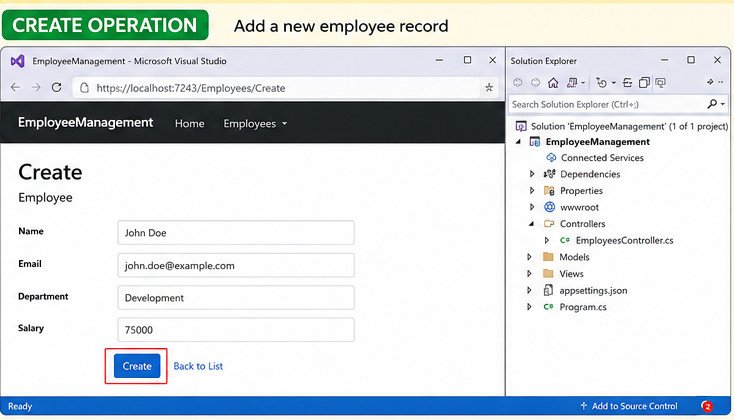
[HttpPost]
public async Task CreateEmployee(Employee employee)
{
    if(ModelState.IsValid)
    {
        _context.Employees.Add(employee);

        await _context.SaveChangesAsync();

        return Ok("Employee Created Successfully");
    }

    return BadRequest();
}
This API receives employee data from users, validates request information,
stores records using Entity Framework Core and returns a success response.
Create functionality inserts new data into the database. In API development, HTTP POST requests are typically used.
Workflow:
- User submits data
- Controller receives request
- Validation occurs
- Data is stored through EF Core
- Response returns success message
Validation should always be applied before storing records. Model validation reduces invalid data entry and avoids database inconsistencies.
Read Operation
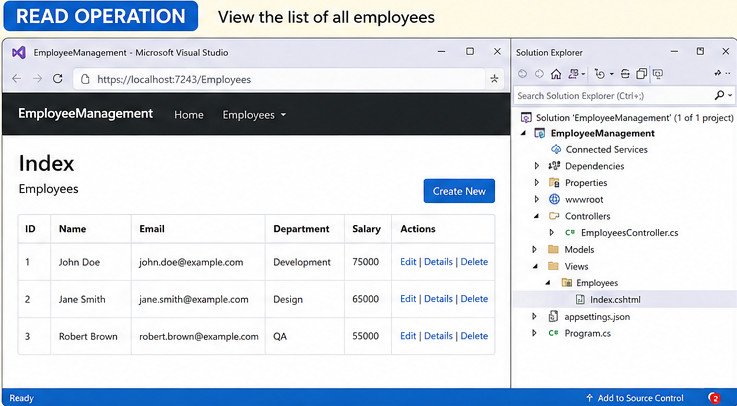
[HttpGet]
public async Task GetEmployees()
{
    var employees =
        await _context.Employees.ToListAsync();

    return Ok(employees);
}
Read retrieves data from a database. It can fetch all records or a specific record using an identifier.
Examples include:
- Get all employees
- Get employee by Id
- Search products
- Filter records
HTTP GET requests commonly handle read operations.
Developers frequently optimize read operations by implementing:
- Pagination
- Filtering
- Sorting
- Caching
Large datasets should not return thousands of records at once because performance degradation can occur.
Update Operation
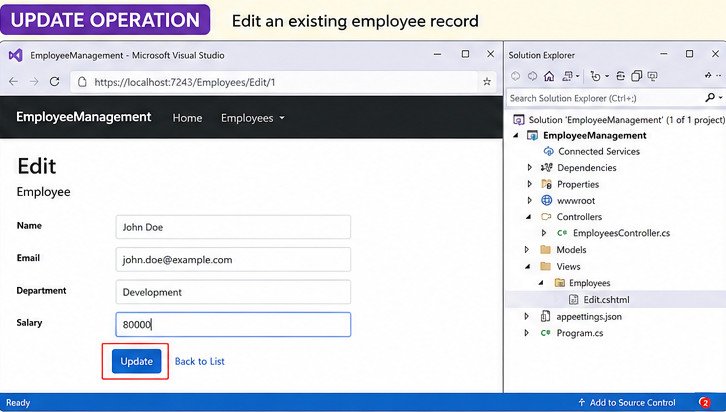
[HttpPut("{id}")]
public async Task
UpdateEmployee(int id, Employee employee)
{
    var emp =
    await _context.Employees.FindAsync(id);

    if(emp==null)
    {
        return NotFound();
    }

    emp.Name=employee.Name;
    emp.Email=employee.Email;

    await _context.SaveChangesAsync();

    return Ok("Updated Successfully");
}
This method searches records using IDs and updates employee information
inside the SQL database.
Update functionality modifies existing records. HTTP PUT and PATCH methods are generally used.
Typical update workflow:
- Receive identifier
- Locate record
- Validate incoming data
- Apply modifications
- Save database changes
Developers should verify whether records exist before updating. Failure to check record existence often causes runtime errors.
Delete Operation
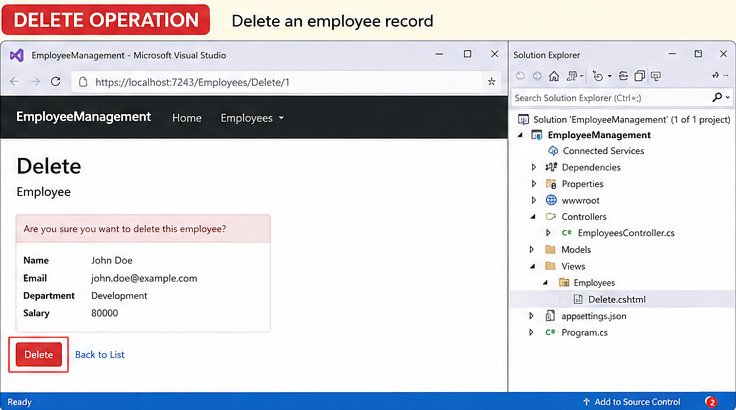
[HttpDelete("{id}")]
public async Task
DeleteEmployee(int id)
{
    var employee=
    await _context.Employees.FindAsync(id);

    if(employee==null)
    {
        return NotFound();
    }

    _context.Employees.Remove(employee);

    await _context.SaveChangesAsync();

    return Ok("Deleted Successfully");
}
This endpoint identifies records using employee IDs and permanently
removes data from the database.
Delete removes data permanently from the database.
Most APIs use HTTP DELETE requests.
Common deletion strategies include:
- Hard Delete
- Soft Delete
Hard delete removes records physically.
Soft delete marks data as inactive while retaining information.
Large enterprise applications frequently implement soft delete to maintain historical data and audit trails.
REST API Endpoints Example
CRUD APIs generally follow REST naming conventions.
- GET /api/employees
- GET /api/employees/1
- POST /api/employees
- PUT /api/employees/1
- DELETE /api/employees/1
Consistent naming improves API readability and integration experience.
Common Challenges During CRUD Development
Developers frequently face implementation issues when building CRUD applications.
Validation Problems
Incorrect validation can store bad data.
Performance Issues
Inefficient queries increase execution time.
Concurrency Conflicts
Multiple users updating records simultaneously may create conflicts.
Improper Exception Handling
Unhandled exceptions reduce reliability.
ASP.NET Core middleware and logging tools help address these issues.
Best Practices for CRUD Operation in ASP.NET Core
- Use repository or service patterns
- Implement DTO models
- Add model validation
- Use asynchronous methods
- Enable centralized exception handling
- Implement pagination
- Secure APIs using authentication
- Use dependency injection
- Keep controllers lightweight
Following these practices improves maintainability and performance.
Security Considerations
CRUD APIs often expose sensitive information. Security should never be ignored.
Consider implementing:
- JWT authentication
- Role-based authorization
- Input validation
- HTTPS enforcement
- Rate limiting
Secure applications protect both business logic and customer data.
Conclusion and Next Step
Understanding CRUD operation in ASP.NET Core is a core skill for backend and API developers. Almost every application relies on creating, reading, updating, and deleting records. ASP.NET Core combined with Entity Framework Core provides a clean and scalable way to build these features.
Once you understand the architecture and flow, implementing CRUD becomes straightforward. Focus on clean code structure, performance optimization, validation, and security practices.
Developers who master CRUD concepts build stronger APIs and more maintainable applications.
Implementing efficient Create, Read, Update, and Delete operations is the core of RESTful service development. Strengthen your backend architecture with Advanced .NET Development: Complete Guide for Enterprise Applications. Build your initial endpoint layout using How to Create an ASP.NET Core Web API, handle data persistency via Code First Approach in EF Core, and follow standard response conventions from REST API Best Practices.