
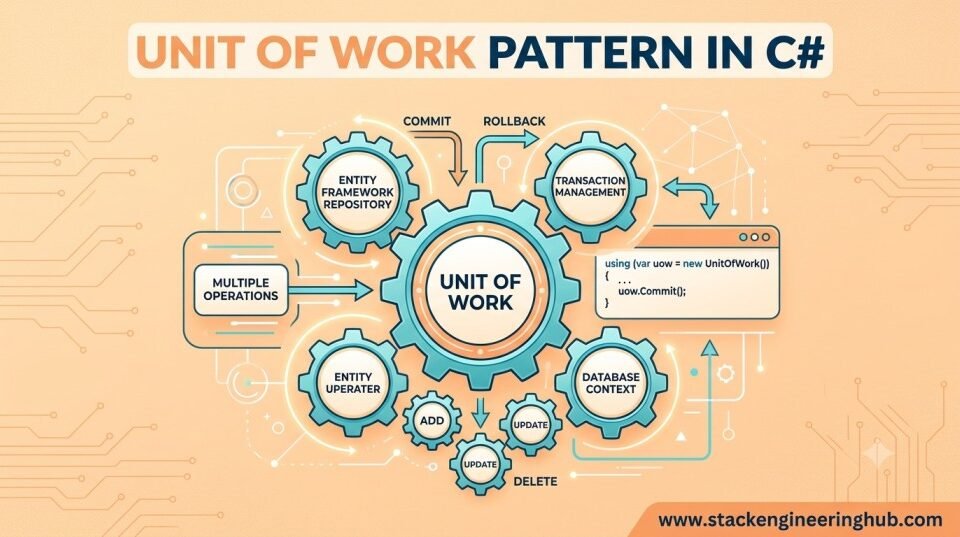

Unit of Work Pattern in C#: Complete Guide with Real-World Example
The Unit of Work Pattern is a software design pattern used to coordinate multiple database operations as one logical business transaction. It is especially useful when an application performs several related inserts, updates, or deletes and all of them must succeed or fail together. Instead of allowing each repository to save changes independently, the Unit of Work keeps track of the work performed during a business operation and commits it at a controlled point. In .NET applications, this pattern is commonly discussed with the Repository Pattern and Entity Framework Core because a DbContext already provides many Unit of Work capabilities. Understanding when to use the pattern—and when not to use it—helps developers avoid unnecessary abstraction while still maintaining clean, testable, and reliable application architecture.
What Is the Unit of Work Pattern?
The Unit of Work Pattern maintains a list of operations that belong to a single business transaction and coordinates their execution. The main idea is simple: perform several related database operations first and commit them together instead of saving every operation independently.
For example, consider an e-commerce application where placing an order requires creating an order record, adding order items, reducing product stock, and creating a payment record. These operations are related. If the order is created successfully but stock is not updated, the database can become inconsistent. A Unit of Work can coordinate these changes so that the complete operation is committed together.
Why Do We Need Unit of Work?
Without a coordinated transaction strategy, different parts of an application may independently call database save operations. This can create partial updates when one operation succeeds and another fails. The Unit of Work Pattern provides a central point where changes can be committed or rolled back based on the outcome of the business operation.
This becomes particularly useful in applications that have multiple repositories. Instead of each repository deciding when database changes should be permanently saved, repositories can prepare changes while the Unit of Work controls the final commit.
Example Scenario
Suppose an employee transfer process requires updating the employee’s department, creating a transfer history record, and updating an audit table. If the department update succeeds but the history insert fails, the application may contain incomplete information. A transaction controlled by a Unit of Work helps ensure that either all related operations are committed or the transaction is rolled back.
Unit of Work and Repository Pattern
The Unit of Work Pattern is frequently used together with the Repository Pattern. A repository generally focuses on data access for a particular entity, while the Unit of Work coordinates multiple repositories and controls the transaction boundary.
For example, an application may have ProductRepository, OrderRepository, and CustomerRepository. Each repository handles operations related to its entity, while the Unit of Work provides access to those repositories and exposes a single SaveChanges or Commit operation.
If you are learning repository-based architecture, the Repository Pattern and Advanced .NET Development guide is a useful related resource.
Basic Unit of Work Architecture
A typical implementation contains interfaces, repositories, a Unit of Work implementation, a database context, and an application service. The service performs the business operation, repositories perform entity-specific data operations, and the Unit of Work commits the complete operation.
Application Service
        |
        v
    Unit of Work
     /       \
    v         v
Product     Order
Repository  Repository
     \       /
      \     /
       v   v
      DbContext
          |
          v
       Database
This structure separates responsibilities. The business layer does not need to know how individual database operations are implemented, while the data-access layer remains responsible for persistence.
Creating a Unit of Work Interface
The first step is to define an interface that exposes the repositories and the operation responsible for committing changes.
public interface IUnitOfWork
{
    IProductRepository Products { get; }
    IOrderRepository Orders { get; }

    Task<int> SaveChangesAsync();
}
The interface provides a clean abstraction for the application layer. It also makes the component easier to mock when writing unit tests.
Implementing the Unit of Work
The implementation can use Entity Framework Core’s DbContext. The DbContext tracks entity changes and provides SaveChanges and SaveChangesAsync methods, making it naturally suitable for Unit of Work-style behavior.
public class UnitOfWork : IUnitOfWork
{
    private readonly ApplicationDbContext _context;

    public IProductRepository Products { get; }
    public IOrderRepository Orders { get; }

    public UnitOfWork(
        ApplicationDbContext context,
        IProductRepository products,
        IOrderRepository orders)
    {
        _context = context;
        Products = products;
        Orders = orders;
    }

    public async Task<int> SaveChangesAsync()
    {
        return await _context.SaveChangesAsync();
    }
}
The important point is that repositories can make changes to the tracked entities without independently committing every operation. The Unit of Work decides when the changes should be persisted.
Using Unit of Work in a Service
The business service can now use multiple repositories through one Unit of Work. Consider a simple order creation operation.
public class OrderService
{
    private readonly IUnitOfWork _unitOfWork;

    public OrderService(IUnitOfWork unitOfWork)
    {
        _unitOfWork = unitOfWork;
    }

    public async Task CreateOrderAsync(Order order)
    {
        _unitOfWork.Orders.Add(order);

        foreach (var item in order.Items)
        {
            var product = await _unitOfWork.Products.GetByIdAsync(item.ProductId);

            product.Stock -= item.Quantity;
        }

        await _unitOfWork.SaveChangesAsync();
    }
}
In this example, the order is added and product stock is modified before SaveChangesAsync is called. Entity Framework Core can detect the changes and send the required database commands when the Unit of Work commits the operation.
Unit of Work with Transactions
For operations that require explicit transaction control, the Unit of Work can expose transaction methods or internally manage a database transaction. A transaction is particularly important when several database operations must be treated as one atomic operation.
using var transaction = await _context.Database.BeginTransactionAsync();

try
{
    _unitOfWork.Orders.Add(order);

    product.Stock -= order.Quantity;

    await _unitOfWork.SaveChangesAsync();

    await transaction.CommitAsync();
}
catch
{
    await transaction.RollbackAsync();
    throw;
}
The transaction ensures that the database does not remain in a partially updated state when an exception occurs. In production applications, transaction boundaries should be designed around actual business operations rather than added to every database call.
Unit of Work in ASP.NET Core
Unit of Work works naturally with ASP.NET Core Dependency Injection. The Unit of Work and DbContext are commonly registered with a scoped lifetime so that one instance is used within an HTTP request.
builder.Services.AddScoped<IUnitOfWork, UnitOfWork>();
builder.Services.AddScoped<IProductRepository, ProductRepository>();
builder.Services.AddScoped<IOrderRepository, OrderRepository>();
Dependency Injection reduces tight coupling and makes application components easier to test and replace. For a deeper explanation, see the Dependency Injection in ASP.NET Core guide.
Advantages of the Unit of Work Pattern
The Unit of Work Pattern provides several architectural benefits when it is applied to the right type of application.
- Coordinates multiple repository operations.
- Provides a clear transaction boundary.
- Helps prevent partial database updates.
- Centralizes database commit logic.
- Supports cleaner separation of responsibilities.
- Can improve testability when abstractions are useful.
- Works well with repository-based architectures.
- Supports maintainable enterprise application designs.
Disadvantages and Limitations
The Unit of Work Pattern is not automatically beneficial for every .NET project. Adding an abstraction over an abstraction can increase complexity without providing meaningful value. This is particularly important with Entity Framework Core because DbContext already provides change tracking and SaveChanges-based Unit of Work behavior.
A custom Unit of Work can also become a large class containing every repository in the application. Such a design may create a service locator-like structure and make dependencies harder to understand. The pattern should therefore be introduced because the application needs coordinated persistence, not simply because it is a commonly used architecture pattern.
Unit of Work vs DbContext
One of the most common questions among .NET developers is whether a custom Unit of Work is necessary when using Entity Framework Core. In many applications, the answer is no. DbContext already tracks changes to entities and persists those changes through SaveChanges or SaveChangesAsync. In that sense, it already behaves like a Unit of Work.
A custom abstraction can still be useful when an organization has a strong repository architecture, needs a consistent application-level abstraction, or combines multiple persistence mechanisms behind one business operation. The decision should be based on project requirements rather than pattern popularity.
When Should You Use Unit of Work?
Use the Unit of Work Pattern when a business operation requires multiple related persistence operations and they should be coordinated as one logical transaction. It can be especially useful in large enterprise applications with several repositories and complex business workflows.
It can also be appropriate when the application needs a clear abstraction between business services and persistence infrastructure. However, for a small CRUD application using Entity Framework Core directly, introducing a custom Unit of Work may add unnecessary code.
Best Practices for Unit of Work in C#
1. Keep the Unit of Work Focused
The Unit of Work should coordinate persistence rather than contain business rules. Business decisions should remain inside application or domain services.
2. Define Clear Transaction Boundaries
Do not create transactions around every database operation. Define a transaction around a meaningful business operation that requires atomicity.
3. Avoid Unnecessary Abstraction
If Entity Framework Core already provides everything the application requires, a custom Unit of Work may not be necessary. Evaluate the actual architectural problem before adding another interface and implementation.
4. Use Dependency Injection
Register repositories and the Unit of Work through Dependency Injection. This keeps components loosely coupled and makes testing easier. You can also review the ASP.NET Core Web API guide to understand how Dependency Injection fits into a modern API architecture.
5. Prefer Async Database Operations
For web applications, asynchronous database operations such as SaveChangesAsync can help applications use server resources efficiently while waiting for database I/O to complete.
Unit of Work and Clean Architecture
The Unit of Work Pattern can fit well into Clean Architecture when persistence concerns are kept inside the infrastructure layer. Application services can depend on interfaces while infrastructure provides the actual implementation using Entity Framework Core or another persistence technology.
This approach helps keep business logic independent of specific database technologies. It can also make future migration or testing easier because application-level code does not directly depend on database implementation details.
For broader .NET architecture concepts, you can explore the Advanced .NET Development guide, which covers Repository Pattern, Unit of Work, SOLID principles, Dependency Injection, and other enterprise development concepts.
Common Mistakes to Avoid
- Creating a custom Unit of Work without a real architectural requirement.
- Calling SaveChanges inside every repository method.
- Putting business logic directly inside the Unit of Work.
- Keeping transactions open longer than necessary.
- Creating one massive Unit of Work containing unrelated responsibilities.
- Ignoring asynchronous database operations in high-concurrency web applications.
- Using incorrect Dependency Injection lifetimes for database-related services.
Unit of Work Pattern Interview Questions
What is the Unit of Work Pattern?
The Unit of Work Pattern coordinates multiple database operations and commits them as one logical unit of work. It helps maintain consistency when several related operations belong to the same business transaction.
Is Unit of Work required with Entity Framework Core?
No. Entity Framework Core’s DbContext already provides change tracking and SaveChanges functionality that represents Unit of Work behavior. A custom implementation should be introduced only when it provides a clear architectural benefit.
What is the difference between Repository and Unit of Work?
A Repository generally manages data-access operations for a particular entity, while a Unit of Work coordinates multiple repositories and controls when their changes are committed.
Can Unit of Work handle transactions?
Yes. A Unit of Work can coordinate database transactions, allowing multiple related changes to be committed together or rolled back when an operation fails.
Conclusion
The Unit of Work Pattern is a useful architectural pattern for coordinating multiple database operations as one logical business transaction. It works particularly well with repository-based enterprise applications where several related changes must be committed consistently. In modern .NET applications, however, developers should understand that Entity Framework Core’s DbContext already provides many Unit of Work capabilities through change tracking and SaveChanges. Therefore, a custom implementation should not be added automatically. Use it when it provides a meaningful abstraction, transaction boundary, or architectural advantage. When combined carefully with Repository Pattern, Dependency Injection, and Clean Architecture principles, Unit of Work can help create maintainable, testable, and reliable .NET applications.
Official Documentation
For the official database context and persistence documentation, refer to Microsoft Learn: Entity Framework Core DbContext.