
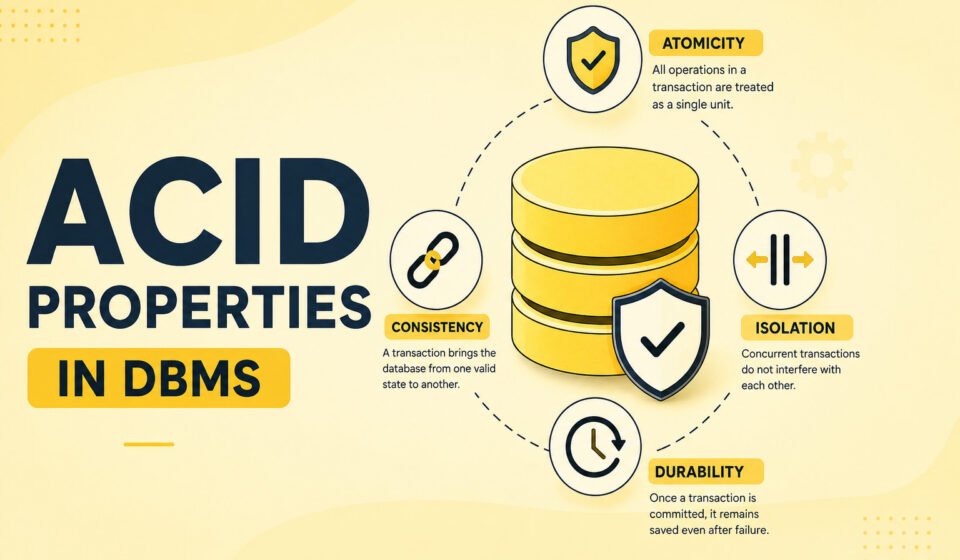

ACID Properties in DBMS: The Foundation of Reliable Database Transactions
Modern applications process thousands or even millions of database transactions every day.
Whether you are building an e-commerce platform, banking application, inventory management
system, or social media platform, maintaining data accuracy is critical.
Imagine a customer transferring money from one bank account to another. If the amount is
deducted from the sender’s account but not added to the receiver’s account due to a system
failure, the database becomes inconsistent. Such situations can cause serious business and
financial problems.
To prevent these issues, database systems follow a set of principles known as
ACID Properties in DBMS. ACID ensures that every database transaction is
processed safely, accurately, and reliably even when multiple users access the system
simultaneously.
In this article, we will explore Atomicity, Consistency, Isolation, and Durability in detail,
along with practical examples that software developers can easily understand.
What Are ACID Properties in DBMS?
ACID is a collection of four properties that guarantee reliable database transactions.
A transaction is a sequence of operations performed as a single unit of work.
The four ACID properties are:
- A – Atomicity
- C – Consistency
- I – Isolation
- D – Durability
These properties help relational database systems maintain data integrity even during
hardware failures, software crashes, or concurrent user access.
Understanding Database Transactions
Before discussing ACID, it is important to understand what a transaction is.
Consider an online banking transfer:
- Deduct ₹1,000 from Account A
- Add ₹1,000 to Account B
- Commit changes
All these operations together form a single transaction.
If any step fails, the entire transaction should be reversed to avoid inconsistent data.
This is where ACID properties become essential.
Atomicity: All or Nothing
What is Atomicity?
Atomicity ensures that a transaction is treated as a single indivisible unit.
Either all operations are completed successfully, or none of them are executed.
In simple terms, Atomicity follows the “all-or-nothing” principle.
Bank Transfer Example
Suppose a customer transfers ₹10,000 from Account A to Account B.
The transaction includes:
- Debit ₹10,000 from Account A
- Credit ₹10,000 to Account B
If the system crashes after debiting Account A but before crediting Account B,
the database must roll back the debit operation.
Without Atomicity, money could disappear from the system.
Why Atomicity Matters
- Prevents partial updates
- Protects data integrity
- Reduces transaction failures
- Ensures reliable business operations
Consistency: Maintaining Valid Data
What is Consistency?
Consistency ensures that every transaction moves the database from one valid state
to another valid state.
Database rules, constraints, and relationships must remain intact after a transaction.
Example of Consistency
Consider a banking database where the total balance across two accounts is ₹50,000.
Before transaction:
- Account A = ₹30,000
- Account B = ₹20,000
After transferring ₹5,000:
- Account A = ₹25,000
- Account B = ₹25,000
The total remains ₹50,000.
Consistency ensures that constraints such as primary keys, foreign keys,
unique values, and business rules are never violated.
Benefits of Consistency
- Maintains database integrity
- Protects business rules
- Prevents invalid records
- Improves application reliability
Isolation: Managing Concurrent Transactions
What is Isolation?
Isolation ensures that multiple transactions running simultaneously do not interfere
with each other.
Each transaction should behave as if it is executing alone in the system.
Real-World Example
Imagine two users trying to purchase the last available product in an online store.
Without Isolation:
- User A sees stock available
- User B also sees stock available
- Both orders get processed
This creates inventory inconsistencies.
With proper Isolation, one transaction completes first, and the second transaction
receives updated inventory information.
Common Concurrency Problems
- Dirty Reads
- Non-Repeatable Reads
- Phantom Reads
- Lost Updates
Isolation Levels
Most database systems provide different isolation levels:
- Read Uncommitted
- Read Committed
- Repeatable Read
- Serializable
Higher isolation provides better consistency but may reduce performance.
Developers must choose the appropriate level based on application requirements.
Durability: Data That Survives Failures
What is Durability?
Durability guarantees that once a transaction is committed, its changes are
permanently stored in the database.
Even if a server crashes immediately after a successful transaction,
the committed data remains safe.
Example of Durability
A customer successfully places an order on an e-commerce website.
After receiving the confirmation message, the server unexpectedly crashes.
Because of Durability, the order information remains stored in the database and
can be recovered when the system restarts.
How Databases Achieve Durability
- Transaction logs
- Write-ahead logging (WAL)
- Database backups
- Replication mechanisms
- Crash recovery processes
ACID Properties Example in a Banking System
Let’s combine all four properties in a single banking transaction.
- Atomicity: Debit and credit operations succeed together.
- Consistency: Total account balance remains correct.
- Isolation: Multiple transfers do not interfere with each other.
- Durability: Completed transactions survive system crashes.
This combination makes banking systems reliable and trustworthy.
ACID vs Non-ACID Databases
| Feature | ACID Databases | Non-ACID Databases |
|---|---|---|
| Data Integrity | High | Variable |
| Consistency | Strong | Eventual |
| Transactions | Fully Supported | May Be Limited |
| Use Cases | Banking, Finance, ERP | Big Data, Analytics |
Why ACID Properties Are Important for Developers
As a software developer, understanding ACID properties helps you design reliable
applications that can handle failures gracefully.
Whether you use SQL Server, PostgreSQL, MySQL, Oracle, or other relational
database systems, ACID plays a critical role in transaction management.
Strong knowledge of ACID also helps developers troubleshoot concurrency issues,
optimize transaction handling, and build enterprise-grade applications.
Additional Resources
Official Reference:
Conclusion and Next Step
ACID Properties in DBMS form the foundation of reliable database systems.
Atomicity ensures complete execution, Consistency maintains valid data,
Isolation prevents transaction conflicts, and Durability guarantees data
persistence after successful commits.
Together, these four principles help organizations maintain accurate,
secure, and dependable databases. Every software developer working with
relational databases should understand ACID concepts because they directly
impact application reliability, performance, and data integrity.
Ensuring transaction consistency, isolation, and durability is essential for financial and enterprise systems. Master enterprise-grade database management with our detailed guide on Advanced SQL Server: Performance Tuning, Optimization & Enterprise Querying. Learn to manage explicit transaction scopes in SQL Transactions Explained, encapsulate transactional logic inside Stored Procedure in SQL Server, and follow system guidelines from Database Design Best Practices.