
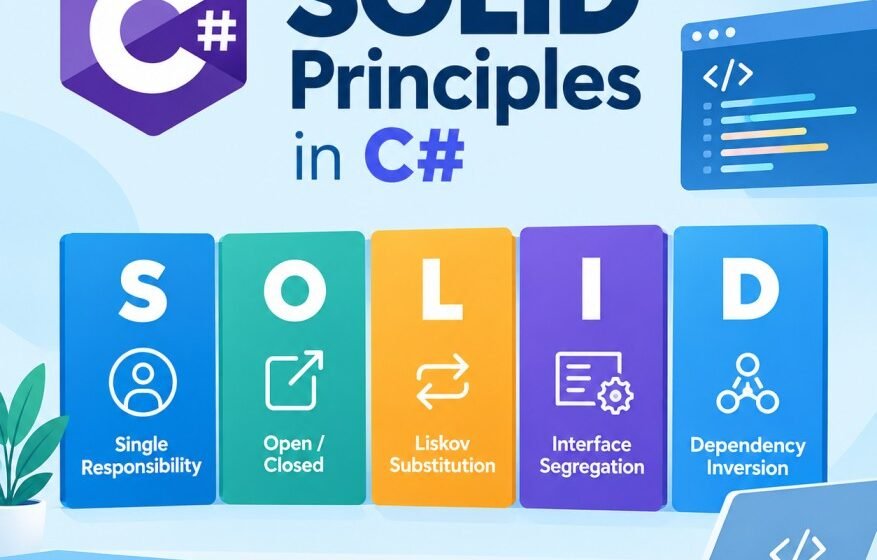

SOLID Principles in C#: A Practical Guide with Real-World Examples
Writing code that works is only the first step in software development. As an application grows, developers must also make sure that the code remains easy to understand, test, modify, and extend. This becomes especially important in enterprise C# and .NET applications where business requirements change frequently and multiple developers work on the same codebase. The SOLID Principles in C# provide a practical set of object-oriented design principles that help developers create loosely coupled, maintainable, and flexible software. SOLID represents five principles: Single Responsibility Principle, Open/Closed Principle, Liskov Substitution Principle, Interface Segregation Principle, and Dependency Inversion Principle. These principles are not strict rules that must be applied mechanically to every class. Instead, they provide design guidance that helps developers recognize tightly coupled, difficult-to-maintain code and improve its structure.
What Are SOLID Principles in C#?
SOLID is an acronym for five object-oriented programming principles used to improve software design. The principles were popularized through the work of Robert C. Martin and are widely used in modern software development. Microsoft also discusses SOLID as an important approach for creating maintainable and loosely coupled .NET applications.
The five SOLID principles are Single Responsibility Principle (SRP), Open/Closed Principle (OCP), Liskov Substitution Principle (LSP), Interface Segregation Principle (ISP), and Dependency Inversion Principle (DIP). Together, they encourage developers to create smaller classes, meaningful abstractions, replaceable implementations, and clear dependencies.
Why Are SOLID Principles Important?
Large applications can become difficult to maintain when classes contain too many responsibilities or directly depend on concrete implementations. A small business requirement can then require changes across several unrelated areas. SOLID principles help reduce these problems by encouraging better separation of responsibilities and lower coupling.
- Improves code maintainability
- Reduces tight coupling between classes
- Makes unit testing easier
- Supports application extensibility
- Improves readability and code organization
- Reduces the risk of breaking existing functionality
For developers working with ASP.NET Core, Web APIs, background services, and enterprise applications, SOLID principles are particularly useful because applications typically contain controllers, services, repositories, integrations, business rules, and infrastructure components.
1. Single Responsibility Principle (SRP)
The Single Responsibility Principle states that a class should have one responsibility and should have only one reason to change. The goal is not necessarily to make every class extremely small. Instead, a class should focus on one clearly defined area of responsibility.
Example of SRP Violation
public class EmployeeService
{
    public void SaveEmployee(Employee employee)
    {
        // Save employee to database
    }

    public void SendEmail(Employee employee)
    {
        // Send email
    }

    public void GenerateReport(Employee employee)
    {
        // Generate employee report
    }
}
This class handles database operations, email communication, and report generation. These responsibilities can change independently. A change in the email provider should not require modifying the database-related functionality.
Applying SRP
public class EmployeeRepository
{
    public void Save(Employee employee)
    {
        // Save employee
    }
}

public class EmailService
{
    public void Send(Employee employee)
    {
        // Send email
    }
}

public class EmployeeReportService
{
    public void Generate(Employee employee)
    {
        // Generate report
    }
}
Now each class has a clear purpose. This makes the classes easier to test, understand, replace, and maintain. SRP is especially useful when business logic grows because it prevents a single service class from becoming a large collection of unrelated operations.
2. Open/Closed Principle (OCP)
The Open/Closed Principle states that software entities should be open for extension but closed for modification. In simple terms, existing working code should not need to be repeatedly changed whenever a new behavior is introduced.
Consider a payment system that supports multiple payment methods. A poor implementation may use a large switch statement and require modifying the same class whenever a new payment method is introduced.
Better Approach Using Abstraction
public interface IPaymentProcessor
{
    void ProcessPayment(decimal amount);
}

public class CreditCardProcessor : IPaymentProcessor
{
    public void ProcessPayment(decimal amount)
    {
        // Credit card payment
    }
}

public class PayPalProcessor : IPaymentProcessor
{
    public void ProcessPayment(decimal amount)
    {
        // PayPal payment
    }
}
A new payment implementation can now be added without changing the existing payment processors. For example, a developer can create a UpiPaymentProcessor class that implements IPaymentProcessor. This approach reduces the chance of introducing regressions into existing functionality.
3. Liskov Substitution Principle (LSP)
The Liskov Substitution Principle states that objects of a derived class should be replaceable with objects of the base class without changing the correctness of the application. In practical terms, inheritance should represent a valid behavioral relationship, not simply a relationship that makes the code compile.
Example of an LSP Problem
public class Bird
{
    public virtual void Fly()
    {
        Console.WriteLine("Flying");
    }
}

public class Penguin : Bird
{
    public override void Fly()
    {
        throw new NotSupportedException();
    }
}
A Penguin is a bird biologically, but the example demonstrates a problem with the software abstraction. Code expecting every Bird to fly will fail when it receives a Penguin. The derived class cannot safely substitute the base class.
Improved Design
public abstract class Bird
{
}

public interface IFlyingBird
{
    void Fly();
}

public class Eagle : Bird, IFlyingBird
{
    public void Fly()
    {
        Console.WriteLine("Eagle is flying");
    }
}

public class Penguin : Bird
{
}
The improved design separates the general Bird concept from the flying behavior. This makes the abstraction more accurate and prevents derived classes from implementing behavior that they cannot support.
4. Interface Segregation Principle (ISP)
The Interface Segregation Principle states that clients should not be forced to depend on methods they do not use. Instead of creating one large interface containing unrelated operations, developers should create smaller and more focused interfaces.
Large Interface Example
public interface IWorker
{
    void Work();
    void Eat();
    void Sleep();
}
Suppose an application has a RobotWorker that can work but does not eat or sleep. Implementing the complete interface forces the robot to provide meaningless implementations for methods it does not need.
Applying ISP
public interface IWorkable
{
    void Work();
}

public interface IEatable
{
    void Eat();
}

public interface ISleepable
{
    void Sleep();
}

public class HumanWorker : IWorkable, IEatable, ISleepable
{
    public void Work() { }
    public void Eat() { }
    public void Sleep() { }
}

public class RobotWorker : IWorkable
{
    public void Work() { }
}
The interfaces are now focused and clients depend only on the capabilities they require. This design also makes mocking and unit testing easier because tests can work with smaller abstractions.
5. Dependency Inversion Principle (DIP)
The Dependency Inversion Principle states that high-level modules should not depend directly on low-level modules. Both should depend on abstractions. Abstractions should not depend on details; details should depend on abstractions.
Example of Tight Coupling
public class OrderService
{
    private readonly SqlOrderRepository _repository;

    public OrderService()
    {
        _repository = new SqlOrderRepository();
    }

    public void CreateOrder(Order order)
    {
        _repository.Save(order);
    }
}
OrderService is tightly coupled to SqlOrderRepository. Replacing SQL Server with another persistence mechanism would require modifying the high-level service. Testing the service can also become difficult because it directly creates the repository.
Using an Abstraction
public interface IOrderRepository
{
    void Save(Order order);
}

public class SqlOrderRepository : IOrderRepository
{
    public void Save(Order order)
    {
        // Save order to SQL Server
    }
}

public class OrderService
{
    private readonly IOrderRepository _repository;

    public OrderService(IOrderRepository repository)
    {
        _repository = repository;
    }

    public void CreateOrder(Order order)
    {
        _repository.Save(order);
    }
}
The service now depends on IOrderRepository instead of the concrete SQL implementation. This is where Dependency Injection becomes useful. The required implementation can be supplied from outside the class, allowing the same service to work with SQL Server, a mock repository, or another implementation.
For more information about Dependency Injection and how it supports loosely coupled .NET applications, developers can refer to the official Microsoft documentation on .NET dependency injection.
SOLID Principles and Dependency Injection in .NET
Dependency Injection is closely related to the Dependency Inversion Principle. In modern .NET applications, dependencies can be registered in the built-in dependency injection container and injected into controllers, services, repositories, and other components.
builder.Services.AddScoped<IOrderRepository, SqlOrderRepository>();
builder.Services.AddScoped<OrderService>();
The application can then inject OrderService where it is required. This approach avoids unnecessary object creation inside business classes and makes dependencies explicit.
A useful warning is that Dependency Injection does not automatically make an application SOLID. If a class requires a very large number of dependencies, that can indicate that the class has too many responsibilities. Microsoft also identifies excessive dependencies as a possible sign that a class violates the Single Responsibility Principle.
How SOLID Principles Work Together
The five principles should not be considered isolated rules. They often support one another. SRP encourages focused classes, OCP makes those classes easier to extend, LSP ensures abstractions remain substitutable, ISP creates smaller interfaces, and DIP reduces dependency on concrete implementations.
For example, an ASP.NET Core application may contain an OrderController, OrderService, IOrderRepository, SqlOrderRepository, EmailService, and PaymentProcessor. Each component can have a focused responsibility while interfaces separate high-level business logic from infrastructure details.
This type of design also fits naturally with larger architectural approaches such as Clean Architecture, layered architecture, and Domain-Driven Design. SOLID does not replace an architecture, but it helps developers make better design decisions inside that architecture.
Common Mistakes When Applying SOLID
1. Creating Interfaces for Everything
Not every class needs an interface. Creating abstractions without a real design reason can add unnecessary complexity. Interfaces are most valuable when they represent meaningful contracts, support multiple implementations, or improve separation between application layers.
2. Making Classes Too Small
SRP does not mean that every method must become a separate class. Splitting code excessively can make an application harder to navigate. Responsibilities should be separated when they have different reasons to change or represent different concerns.
3. Using Inheritance Incorrectly
Inheritance should represent a valid behavioral relationship. If a derived class needs to disable, ignore, or throw exceptions for important base-class operations, the abstraction should be reconsidered.
4. Overusing Dependency Injection
Dependency Injection is powerful, but it should not become a replacement for thoughtful design. Inject only the dependencies a class actually needs and avoid creating service-locator-style designs where dependencies are resolved indirectly throughout the application.
SOLID Principles in Real-World ASP.NET Core Applications
In a real ASP.NET Core project, SOLID principles can be applied across controllers, services, repositories, API integrations, authentication components, logging systems, and background processing. A controller should primarily handle HTTP concerns, while business rules should normally live in application or domain services.
For example, centralized error handling can keep controllers focused on request processing instead of forcing every action to contain large try-catch blocks. You can learn more about this approach in our guide to Exception Handling in ASP.NET Core.
Logging is another area where separation of concerns is important. Application components can depend on the ILogger abstraction rather than directly creating a particular logging implementation. For practical guidance, see Logging in ASP.NET Core and our newer guide on Serilog in .NET.
SOLID principles also become increasingly important as an application evolves toward enterprise-level architecture. For a broader discussion of maintainability, scalability, and enterprise application design, see Advanced .NET Development.
Benefits of Using SOLID Principles
- Maintainability: Focused classes are easier to understand and modify.
- Testability: Abstractions make dependencies easier to mock and replace.
- Extensibility: New functionality can often be added without changing stable code.
- Loose Coupling: Components become less dependent on concrete implementations.
- Readability: Well-designed classes communicate their purpose clearly.
- Reduced Risk: Smaller changes are less likely to affect unrelated parts of an application.
Final Thoughts
SOLID Principles in C# provide practical guidance for designing maintainable and flexible object-oriented applications. The five principles—Single Responsibility, Open/Closed, Liskov Substitution, Interface Segregation, and Dependency Inversion—help developers control complexity as applications grow. They encourage focused classes, meaningful interfaces, replaceable implementations, and clear dependency relationships.
The most important point is that SOLID should not be treated as a checklist. Applying every principle everywhere can create unnecessary abstractions and complexity. Instead, developers should use SOLID to identify design problems and make appropriate improvements. When used with good object-oriented design, dependency injection, clean architecture, testing, and clear separation of concerns, SOLID can significantly improve the long-term quality of C# and .NET applications.
If you are building ASP.NET Core applications or enterprise .NET systems, start by applying one principle at a time. Look for large classes, duplicated conditional logic, inappropriate inheritance, oversized interfaces, and direct dependencies on concrete implementations. These are often good opportunities to apply SOLID principles and gradually create cleaner, more maintainable software.
For additional guidance on SOLID and enterprise application design, developers can also consult Microsoft’s official .NET architecture documentation and related engineering guidance.
Related Reading: How to Create an ASP.NET Core Web API | Exception Handling in ASP.NET Core | Logging in ASP.NET Core | Advanced .NET Development
Official Reference: Microsoft Learn: C# Best Practices – Dangers of Violating SOLID Principles in C#
“`